
Since 2022 a new boom started for AI with ChatGPT entering the mainstream and immediately we heard that we’re entering a new era where “AI will replace jobs.”. Well… as a person who has a degree in computer science and knows how LLMs actually work (it’s not really AI, but marketing says otherwise), it amazed me that corporations immediately picked it up as a human replacement.
Three years in, we are facing “AI Fatigue” in customer support and we’re getting to a point when we finally need to understand how AI can really be utilized to have a positive impact on business.
It starts with KPI driven support
For years, many companies have seen support as a cost center. The goal became cutting costs and chasing KPIs, not actually helping people.
Instead of:
- “Your job is to keep our customers happy”
it became:
- “You must close 100 tickets this week”
That mindset spreads across the whole company. Support agents start seeing customers as problems. Managers look only at numbers. And when AI arrived, it was sold as a magic shortcut.
So instead of:
- “Let’s help our customers more efficiently”
we got:
- “Let’s reduce ticket volume and push AI in front of the client”
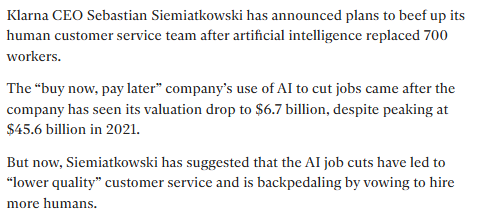
One of the most famous examples was Klarna. It looked good on spreadsheets, but customers hated it. They had to rethink the whole move:
AI Chatbots shift responsibility to customers
Imagine this situation: you have a problem with your bank account. You go to your bank’s page for help. You want to speak with someone who can respond quickly and understand the urgency. Instead, you are forced to use a chatbot. It doesn’t understand, it doesn’t feel what you feel, not to mention empathy.
What the bank essentially did was shift the responsibility of solving the problem to you!
Look, I use ChatGPT on a daily basis. But it never gives me exactly the right text on the first try. It always takes a few iterations and edits before I can use it for my post. And remember, I do this on purpose and I know what I am looking for.
So why are we forcing customers to use AI and expecting them to know how to use it efficiently?
Customers have had enough
If you’ve had these bad experiences, eventually you get triggered whenever you even see that it’s a bot helping you. You just don’t want to use it at all. What’s also important: the price of the service stays the same, but the support experience gets worse!
The outcome is obvious. People now spot AI and think: “Ah, they just want to save money on me”. They feel dismissed. They feel the company is hiding behind automation. And once that feeling appears, you’ve lost trust.
That is AI Fatigue.
Even in the web hosting industry there are companies that proudly announce they do NOT use AI for support at all. Now that is an interesting way to distinguish yourself from competition!
Ignoring AI is also a bad idea
AI is not a magic tool that can replace people. That’s just wishful thinking. But in my opinion, at the same time, ignoring AI is silly! If AI wasn’t good enough, ChatGPT wouldn’t have 200m+ unique users each month.
The key? Finding balance!
AI should not be forced on customers or used as a shortcut. It should run the support process intelligently, using real understanding of tickets, customers and services
Simple and repetitive tickets should be automated… but automation should only be used when the system is properly integrated and has enough context to make the right decision.
When a case is more complex, AI should route it to a human with clear tasks and ready-to-send replies. This reduces back-and-forth, speeds up resolution, and keeps support quality consistent.
The goal of AI is not to replace support teams, but to remove unnecessary work and help people focus on real problems. That is the philosophy behind Konrado.AI.
How to implement AI with care?
Here are 5 rules I recommend for any company, based on the experiences I’ve gathered so far with onboarding KonradoAI and through numerous discussions we’ve had while gathering feedback for our application:
- Automate what makes sense – AI should only act on its own when it has enough context and confidence.
- Make your team faster – Writing good replies takes time. Let AI draft answers so your agents can focus on fixing the real issue.
- Improve clarity – AI is great at expanding thoughts. Use it to write clearer, more complete answers that reduce endless back and forth.
- Offer a smart alternative – if your human reply takes hours, let AI try to help in the meantime. It won’t solve everything, but it gives the customer a chance.
- Be proactive – if someone is browsing your pricing page, why not gently ask if they have questions? AI can guide them to answers fast. No pushing, just helpful presence.
Even if AI helps only 20% of the time, whether by providing faster replies or handling repetitive questions, it’s already a win. Just remember the core rule: support is about helping customers, not fighting them!



Write a Reply