
KonradoAI is now production-ready. Not as a beta experiment. Not as a side project. But as a system that hosting companies can deploy in real support environments.
Getting here took longer than I expected. And the product we have today looks different from what I originally imagined.
I decided to write this as a personal reflection on how it started, where it broke, what forced us to change direction and why this version finally makes sense to me. It also explains why I believe KonradoAI, as a product, has big long-term potential.
2022: When The Idea Felt Too Obvious
When ChatGPT became mainstream in 2022, the idea felt almost too obvious. If AI is good at generating text, it should work well in support, right? Hosting support is largely text-based and repetitive and, in theory, with proper integrations into third-party systems like cPanel or Proxmox, it can be heavily automated. On paper, it looked like a perfect fit.
And yet, a few years in, there still wasn’t a solution even close to what I had envisioned. Even in 2026, in my view, only a handful of large players like Hostinger, GoDaddy or Hosting.com have implemented it properly.
At the same time, the market reaction made me uncomfortable. Many companies immediately framed AI as a cost-cutting tool. Replace people. Automate everything. Reduce headcount.
Very quickly, there was pushback. Customers did not want to lose the human touch. Support teams were skeptical. Early AI implementations often felt shallow and disconnected from real workflows (they still are). I even wrote about what I called AI fatigue, because the hype was running far ahead of actual value.
Still, I did not start back then. Over the years I learned one hard rule: DO NOT build a new project without an experienced team. At the time, no one around had real experience in building AI solutions.
Things changed when I found out that my former employee, Artur Pilch, had been building his own AI tools. Around the same time, he was looking for a new role. That is when it clicked and we got to work.
The First Version and the First Reality Check
We started building KonradoAI early 2025. Our first approach was intentional and actually a bit conservative. We focused on deep integrations and started with a copilot model for support agents. I specifically avoided building a chatbot first. The chatbot market was already crowded and that tied into another lesson I’ve learned over the years: find a blue ocean.
So we built a system that supported agents. It prepared replies, suggested actions, pulled context from connected systems and reduced friction in daily work. Technically, it worked. The integrations were strong. The system understood the environment it was operating in.
Then came the most basic question that you could expect:
Client: “If I pay 500 dollars per month, what exactly do I gain?”
Me: “What do you mean? Isn’t your support team more effective now? Aren’t they responding faster?”
Client: “Well… not that much.”
Clearly, the value was not visible enough to justify the cost.
The Hard Part: Control Over The Process
So why were the results not that clear in practice? In theory it was a great plan, right? Well.. in reality, we had to learn the hard way that: Control over the process matters more than technology.
When a company builds its own internal AI system, it controls the entire rollout. It sets the processes, decides how it’s used and can require the team to adopt it.
When we enter as an external system, reality is different. There is friction. There are managers to align with. The company owner may love the idea, but the support team manager is skeptical. In some cases, the agents themselves actively sabotage it and do their best not to use our tool (in their mind it’s the tool that will replace them).
So, you then look at the statistics and the impact is simply not there.
This forced us to simplify aggressively and focus on impact that is visible early. If value is not obvious fast, adoption stalls.
The Pivot
After the first real deployments, one conclusion became impossible to ignore. Without automation, there is no strong value story. Automation is what changes the outcome very fast and very clearly.
If a percentage of tickets can be resolved automatically, that is measurable. If time to first reply drops meaningfully, that is measurable. If the number of back-and-forth messages per ticket decreases, that is measurable.
This was our pivot. Not because the original idea was wrong, but because value was unclear. Automation could not be a feature we add later. It had to be core. The product had to move from “smart assistant” to “operational system.”
That shift forced difficult prioritization decisions and killed some ideas I personally liked. But it also brought clarity.
If AI does not change economics, it is just a feature.
When ROI Stopped Being a Question
We deliberately kept the beta small. I did not want to scale confusion or promise too much too early. Instead, we focused on learning and fast, effective development and improvements for a small scale, but still very good representation of our target customers.
So far, we have onboarded 11 customers, including 8 hosting providers and 3 MSPs, with several more in progress. More importantly, we started seeing results that were no longer subjective.
Depending on the setup, we were able to deliver very clear, measurable results:
- Up to 30 percent of replies handled fully automatically
- Another 50 percent replied with our co-pilot with AI-prepared responses and TODO list
- Roughly 40 percent faster time to first reply
- Even 42% fewer back-and-forth messages per ticket
- More consistent support quality across the entire team
- Faster onboarding of new agents
At some point, the question changed from “Where is the value?” to “When can we deploy?”.
It seems we’ve found it.
From Experiment to Production-Ready
After a few more rounds of improvements I am finally able to say that KonradoAI is production-ready.
For me, production-ready does not mean feature-complete. It does not mean perfect. It means something much more serious. It means we are no longer experimenting with ideas. We are operating inside real support environments, affecting real customers, real SLAs and real business metrics.
There is a psychological difference between building something interesting and being responsible for someone else’s support operations. Once automation starts handling tickets and influencing response times, there is no room for “let’s see how it goes.”
What We Are Building Next
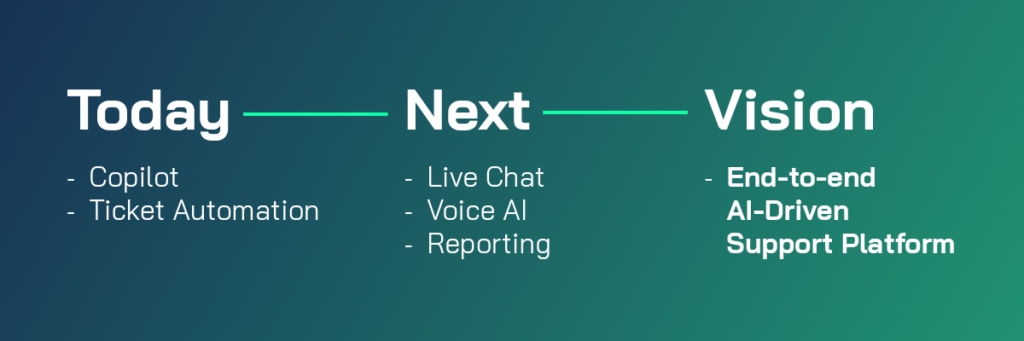
Production-ready does not mean finished. We still have clear plans to expand the system with additional AI-driven tools that can further elevate support operations. Today, KonradoAI covers deep integrations, agent copilot functionality and ticket-level automation. That is the foundation.
Looking ahead, the most obvious next step is live chat. Many companies want to offer an AI-powered live chat option to their customers, but the real difference is not just automation. It is speed and a more sales-oriented approach to capturing leads directly from the website. This requires a different mindset than technical support that KonradoAI currently focuses on. We already have promising concepts in place and it feels like the right time to execute on them.
Once this sales-oriented logic is in our system, phone support becomes a natural next direction. Current AI models are already good enough that, in many cases, they are indistinguishable from real people. At this point, it is no longer a question of if, but when real-time, AI-powered phone conversations become a practical part of support operations.
In parallel, we will continue investing in advanced reporting and quality monitoring. Managers need visibility not only into speed and volume, but into what is actually happening inside customer conversations. Things like sentiment, clarity and answer quality are all measurable and they matter.
One thing is clear. AI already enables things that were not realistically possible just a short time ago. I want KonradoAI to stay on that wave, be among the pioneers in this space and help companies build better, more predictable support operations.
Why This Direction Feels Right Long-Term
Right now, many companies are experimenting with AI internally. Some build scripts. Some connect APIs. Some run isolated pilots. In many cases, they are rebuilding similar components independently, with mixed results. At the same time, many “legacy support platforms” (aka SaaS) are trying to bend their existing products to include a few AI features, rather than rethinking support as an AI-driven system from the ground up.
On the other end of the spectrum, there are plenty of generic, non-integrated AI chatbots. They look impressive in demos, but they lack context. One thing we learned very quickly while working on KonradoAI is that context is everything. You can run the best models on hundreds of GPUs, but without deep access to real data, systems and history, AI will always fall short.
That is why I believe building an end-to-end, AI-based platform designed specifically for a given industry makes sense. Hosting support has its own workflows, systems and constraints.
My end-game vision for KonradoAI is:
Connect your company to KonradoAI and get a full suite of AI-driven tools that take your support to a completely new level.
Instead of building custom solutions or spending hundreds of hours stitching together generic tools, KonradoAI should be the platform that handles this layer for you. AI will reshape support. The only question is who builds it properly.

Write a Reply