
ModulesGarden, EasyDCIM and PanelAlpha are all part of the INBS.Software ecosystem, each at a different stage of development. But no matter where a product stands, support is where things get real. More users mean more tickets. In web hosting especially, more tickets mean more edge cases, unusual setups, and more digging through documentation to find the right answer.
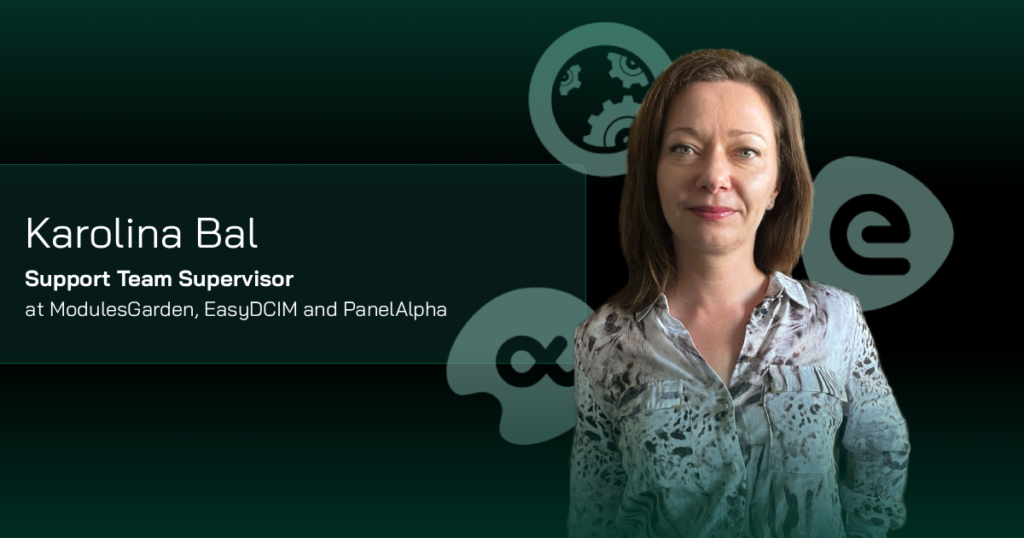
Few people see this up close as often as Karolina Bal, Support Team Supervisor across all three pillars of the INBS.Software ecosystem. So when it came to our first case study, she was the obvious first voice to bring in – someone who knows the wins, the tough tickets, and everything in between.
“ I look after support across all three brands. My role is to keep things steady, make sure our replies are clear, consistent, and helpful, no matter which product or team is involved. Much of that work happens behind the scenes: process, quality checks, coordination. The goal is simple – every customer interaction should feel solid and reliable.
As the volume kept growing, they knew they needed help. That’s when Konrado.AI came in, but… not everyone was convinced at first. There was skepticism and doubt. But instead of forcing trust, they built it. Step by step.
What Automation Means in Practice
Automation in support has never meant random AI suggestions. When a ticket arrives, Konrado.AI analyzes it using documentation, past tickets and recurring patterns across brands.
“ If the case is predictable and confidence is high, the reply is sent instantly. If it’s more complex (as it often is in products as technically deep as ours), the system prepares a structured draft with context and clear steps for our support team members to review.
Its value, however, isn’t limited to simple, repetitive questions.
Konrado.AI is also capable of handling deeply technical scenarios, the kind that normally require significant research, cross-checking older cases, and internal consultations. It connects information across tickets and documentation, often presenting a solution path that previously would take much longer to uncover. In many cases, the team no longer starts from zero. They start with a direction and focus on verification and refinement.
- Instead of writing from scratch, agents refine.
- Instead of digging through old tickets manually, they verify.
- Instead of repeating the same compatibility explanations again and again, they focus on cases that actually require judgment.
Automation Results by Brand
Automation levels vary depending on product complexity and how predictable incoming cases are.
ModulesGarden – 15% Automated Replies
With nearly 80 WHMCS modules, ModulesGarden deals with a wide range of web hosting questions, often tied to specific versions and individual products. Even small differences between versions can change the answer, which naturally lowers automation confidence.
Because of that diversity, automation stabilizes around 15%.
At first glance, that number may not look impressive, but within a portfolio this broad, it represents a strong result. It reduces daily load for Level 1 and Level 2 teams and lowers the number of cases that would otherwise escalate quickly.
In an environment this complex, predictability is limited. And yet, even partial automation makes a visible difference.
PanelAlpha – 21% Automated Replies
PanelAlpha operates within a more focused product scope and benefits from strong, consistent documentation. The product surface is simpler, and ticket patterns repeat more frequently.
As a result, automation reaches around 21%.
Here, the system recognizes recurring questions with higher confidence. Clear documentation makes accurate responses easier to generate, and the technical team provided fast feedback during rollout, which helped quickly improve results.
For a product still in startup mode, this level of automation creates stability.
EasyDCIM – 12% Automated Replies
EasyDCIM has a smaller team, and the cases are often more technical and less repeatable. Many issues require investigation, deeper analysis and environment-specific reasoning.
Automation sits at around 12%.
That percentage reflects the nature of the product, not a limitation of the system. Even here, Konrado.AI plays an important role. It surfaces related historical tickets, highlights relevant documentation sections and prepares structured technical drafts. Instead of spending significant time researching and composing detailed explanations from scratch, the team starts with a solid foundation and focuses on verification.
In highly technical environments, reducing research and writing time alone has a measurable impact.
Cross-Brand Impact (Q3 2025)
Looking at all three brands:
- Replies became 37% faster and more consistent
- The same team handled 18% more cases per day
- Back-and-forth messages per case dropped by 42%
- Average resolution time decreased by 1.4 days
- Around 35% of replies required minimal or no edits
“ We achieved all of this without expanding the support structure. The headcount didn’t change. Focus did.
The Human Layer
Customers remember how the interaction felt long after the ticket is closed. A technically correct reply without clarity or reassurance isn’t enough. Long investigations require communication, not just resolution.
“ Over the years, I’ve repeated one thing: support isn’t only about solving the issue, it is about maintaining trust.
By automating repetitive queries and preparing structured technical explanations, Konrado.AI gives the team more space for complex and sensitive conversations, the ones where tone, context and presence matter most.
Automation handles repetition. People handle relationships.
“ At first, we were concerned that introducing AI might make support feel less human. The opposite happened. By reducing routine workload, it let us be more focused and more present where it truly matters.
From Skepticism to Default
It didn’t click overnight. In the beginning, every reply it generated was reviewed line by line. The team adjusted the tone, cut out awkward phrases, and rewrote weak parts. Trust was built through daily checks and constant feedback.
“ At one point someone suggested we might eventually let it answer tickets on its own. But then a customer opened a ticket that started with “this should be simple” and we remembered how creative our edge cases can get.
No one seriously considered blindly sending replies. That was never really the point of Konrado.AI. Instead, they have kept shaping it. Teaching it. And somewhere along the way, skepticism turned into confidence.
Today, Konrado.AI is part of how they work across three brands. Not because it replaced people (it didn’t), but because it removed friction and gave the team more space to focus on what really matters: clarity, consistency, and long-term relationships.
Support did not become less human. It became more deliberate.

Write a Reply