
In 2025 and 2026, more and more companies are coming to the same conclusion: without AI, support simply does not scale anymore. This is no longer about experimentation or hype. It is a practical operational problem.
Both industry reports and our own case study increasingly point in the same direction. As the number of tickets grows and customers expect faster, more accurate responses, the traditional approach of “hire more people” starts to break down. Costs increase, onboarding slows down, and consistency drops.
The question is no longer “if” but “when” and “how”.
The concern: “AI makes mistakes”
This is the most common objection, and it is valid, Yes, AI makes mistakes, but do do humans.
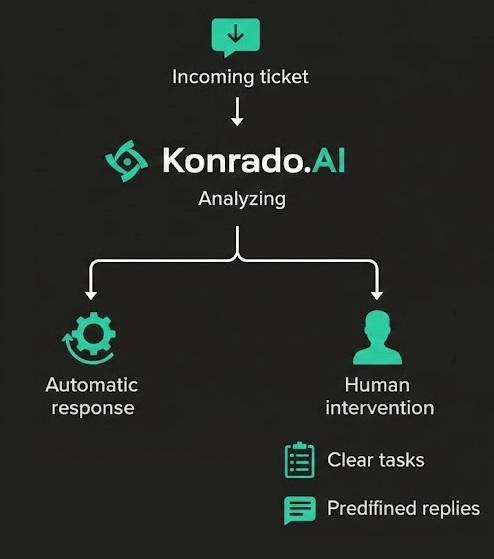
The difference is control. A well-designed system does not try to solve everything automatically. It evaluates confidence and context, then decides whether to respond or pass the case to a human.
In practice:
- repetitive and predictable issues are automated,
- complex or uncertain cases go to humans,
- humans receive context and suggested solutions.
This is not about replacing your team. It is about changing how the team operates.
Costs and the scaling problem
Scaling support by hiring works only up to a point. Over time, training becomes slower, knowledge harder to transfer, and quality less consistent.
AI allows companies to handle more tickets without increasing team size proportionally. It also standardizes responses and reduces the number of interactions needed to resolve issues.
The result is a more stable cost structure and better operational control.
Our philosophy: Balance between AI and humans
The biggest mistake in AI adoption is trying to automate everything. That approach fails. Not all problems should be handled without human involvement. A more effective approach is balance:
- AI handles repetitive work,
- humans handle complex matters,
- AI supports humans in those complex cases.
This is the core philosophy behind Konrado.AI. The system analyzes each case, evaluates confidence, and decides whether to respond automatically or pass it to a human with context and a ready-to-use answer.
Context is everything
You can rent an entire datacenter full of the most powerful GPUs. If you don’t have data, it will NOT work. That is why integrations that are specific to your business are critical:
- ticketing system,
- billing,
- applications and infrastructure,
- knowledge base,
- historical tickets.
Systems like Konrado.AI combine these sources to understand each case, not just the message itself. This is what makes the difference between generic replies and real problem solving.
How to approach implementation
A few practical rules:
1. Do not start with full automation
Start with AI as a support layer for your team.
2. Invest in data
Without a solid knowledge base and integrations, results will be weak.
3. Roll out gradually
Start with suggested replies, then partial automation, then full responses.
4. Measure outcomes
Track time to first response, resolution speed, and automation rate.
5. Involve your team
The biggest challenge is not technology. It is changing how people work.
AI in support is quickly becoming a standard. The real question is not whether to implement it, but how to do it in a controlled and effective way.



Write a Reply